

Autumn Update 2026
We have now almost reached a very significant stage in the project. Very shortly the machining of the cylinder castings and the various covers will be complete. However, there is still a long way to go, to achieve the completion of the power bogie. The first update concentrates solely on the cylinders and shows the tremendous work put into this part of the construction by John Dunn Engineering. Although the castings are now almost finished there is still other work needed in this area, such as pistons and rods, slide bars, crossheads, valve spindles and cylinder drain cocks. Following on there is still the need for coupling and connecting rods, valve gear and the various components making up the brake gear. This means that we are once again asking for the necessary funds to enable us to obtain these parts whilst not forgetting that, although the fund for making our boiler is now over 50% there, we still need your valued support to enable us to achieve our ultimate goal of building our near replica of Gowrie. Thank you for your continued support!
By the time you reach the end of this update you will see that through the various images that follow, the machining of the cylinders and associated parts has reached the point where they are almost finished. We begin with the completion of the cylinder covers, which had been machined to size at our workshop, before being transported to John Dunn Engineering, for the drilling of the holes to attach them to the cylinder castings. The first image in the following sequence shows the drilling of the holes in one of the front cylinder covers. Then moving on to images of the machining of the slide bar faces on the rear covers, plus the drilling and tapping of the holes needed to attach the slide bars to these covers. Having completed these operations the next job on the rear covers is the drilling of the holes to fix them to the cylinder castings.


The photograph below is the final image, showing the completion of the cylinder cover machining. This shows both rear covers with all holes drilled and tapped, including the two into which the long studs for attaching the gland followers are screwed. In the image the gland followers can be seen above the left hand cylinder cover

With the cylinder covers now finished, attention has now once again turned back to further machining of the main cylinder castings. The following three images show the right cylinder casting, from various angles, set up so that the port faces can be machined. Because of all the various different angles that the setups require for the different operations, it can be appreciated that a great deal of head scratching takes place, not only in the positioning, but also in achieving sufficiently rigid support and clamping down to avoid any movement or chatter once the machining starts. Following on from the above, there is one image showing the preliminary stages of milling the sides of the port face. This is followed by the roughing cut on the port face, which was a difficult operation, due to the depth of the valve-chest at the stuffing box end and the limited clearance between the end of the port face and the back of the valve chest.


The next two pictures show the steam chest port face. The first is of the face being machined, whilst the second shows the finished face. The plug in the neck-ring bore is used as a datum to achieve the correct position of the port face and its shoulders. The different hues of colour in the port face are just machining marks, the finish is very good.


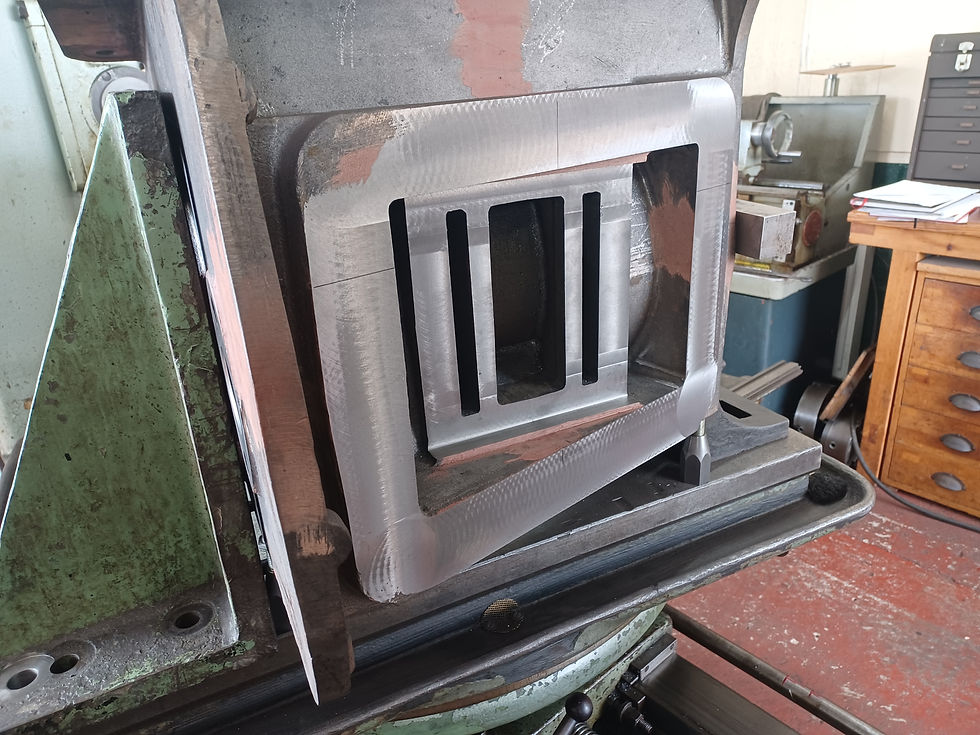
The setup for the next machining operation was easy to achieve, as all it entailed was the swivelling of the borer table to the desired angle, so that the joint face for the steamchest cover could be machined. The following seven images show various stages in the machining of this face to the finishing cut. The final three show the finished face, plus the drilling and tapping of the holes for fixing the steamchest cover down to the cylinder casting.




The drawing above was produced by John Dunn to verify his calculations and confirm that he had correctly interpreted the original drawing with regard to the various angles and dimensions required to achieve the necessary end result. The final machining operation shown on the next two pages, was for the bolting face for the steam inlet manifold onto the cylinder casting. The first image shows the setting up for this, followed by three showing the machining of this face. All that then remains to be done on this casting is the drilling and tapping of the four fixing holes to attach the manifold. Once again, all photographs are courtesy of John Dunn Engineering. That completes the work on the right-hand cylinder. The left one now requires finishing!


As this update demonstrates, the cylinder machining has progressed remarkably well and represents another major milestone in the construction of our new locomotive. The skill, dedication and craftsmanship shown by John Dunn Engineering have brought us significantly closer to seeing the power bogie take shape. Yet, as impressive as this progress is, there remains a substantial amount of work ahead, with many essential components still to be manufactured and fitted. Every donation, no matter the size, helps us move one step closer to completing our replica of Gowrie. We would like to thank all our supporters for their continued generosity and encouragement, and we look forward to sharing further developments as this exciting project continues to gather momentum.


Comments